
NATO and Nuclear Command and Control

WASHINGTON DC 16FEB2026
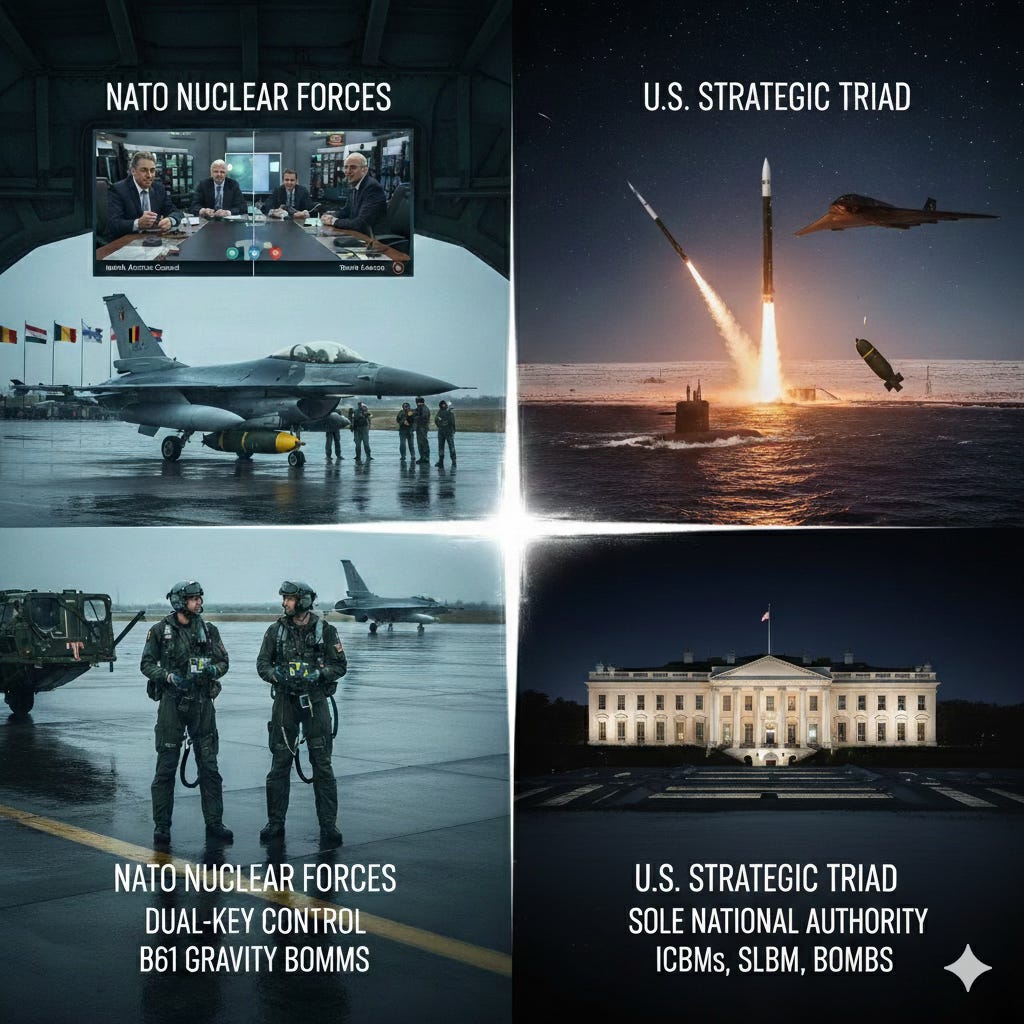
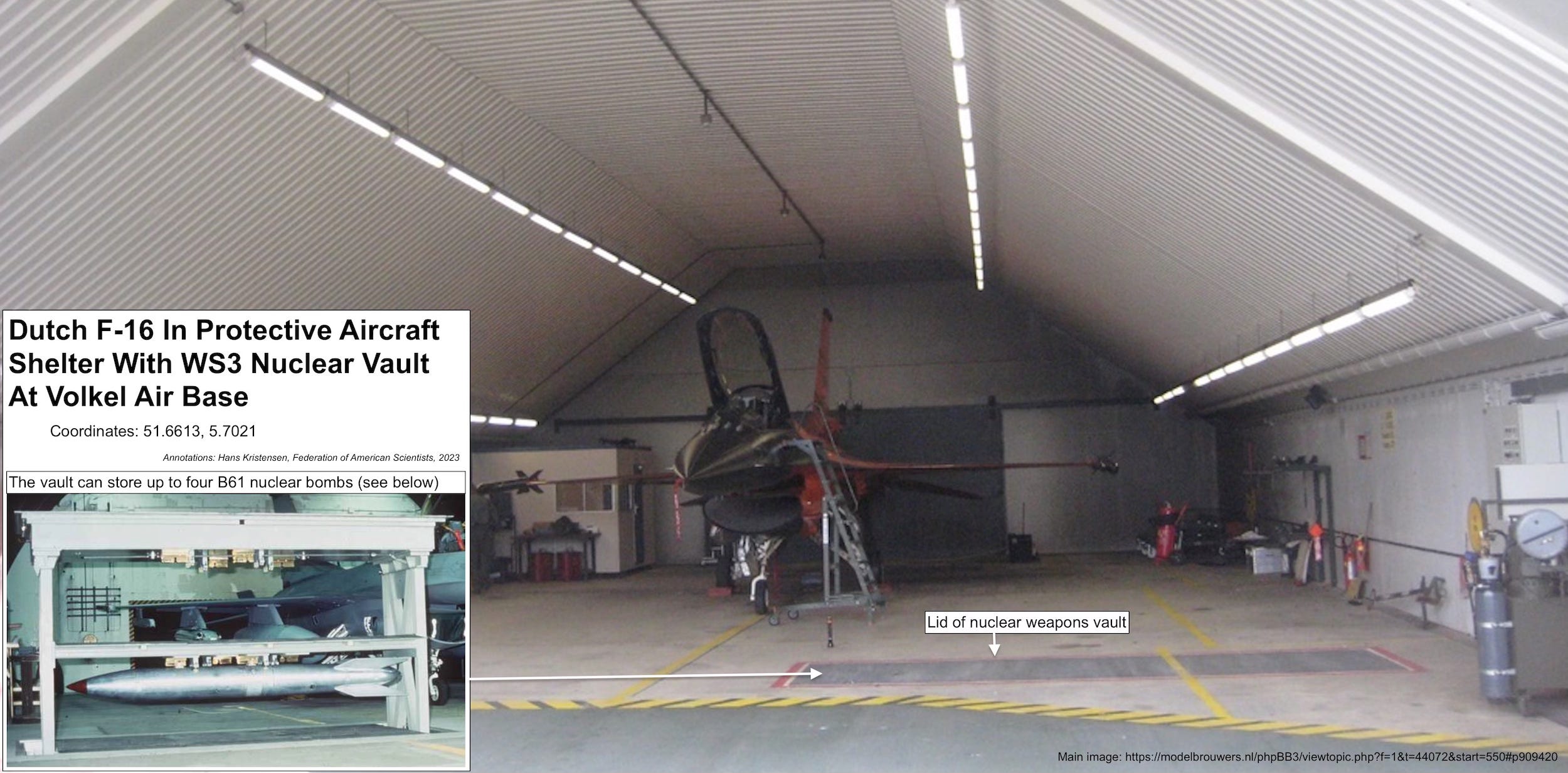
In a NATO context, any decision to employ nuclear weapons involves two distinct categories of U.S. systems. The first consists of the B61 gravity bombs forward‑deployed in Europe. These are “tactical” only in the sense that they are delivered by dual‑capable U.S. or allied aircraft—such as the F‑16 or Tornado—under NATO’s nuclear‑sharing arrangements.
The second category comprises the U.S. strategic nuclear triad based in the continental United States: intercontinental ballistic missiles, submarine‑launched ballistic missiles, and air‑launched cruise missiles, along with U.S.-only variants of the B61 and the B83. These two categories operate under different chains of command, and this article will explain how those command pathways diverge.
NATO’s nuclear decision‑making is governed by a structured consultation process involving the North Atlantic Council (NAC), the Nuclear Planning Group (NPG), and the Nuclear Operations Policy Committee (NOPC). These bodies provide political guidance, not operational control. NATO distinguishes between “time‑permissive” and “time‑urgent” scenarios: in the former, allies are consulted through the NPG and NAC; in the latter, the 2020 Nuclear Matters Handbook notes that the U.S. President “may consult with allies,” but is not required to do so if consultation would jeopardize survivability or response timelines. This asymmetry explains why NATO can approve B61 missions collectively, while U.S. strategic forces operate outside alliance structures.
While these U.S. systems form the backbone of NATO’s nuclear posture, two European allies—France and the United Kingdom—maintain their own national deterrents. These forces sit alongside NATO’s arrangements rather than inside the B61‑based sharing system, and each follows a distinct command‑and‑control model. The next section outlines how France and the UK fit into the broader nuclear landscape.
France and the United Kingdom
Set against this architecture is a crucial exception: France. Unlike the United States and the United Kingdom, France maintains absolute strategic autonomy and remains the only NATO member outside the Nuclear Planning Group. Its Force de Dissuasion—roughly 290 warheads deployed via M51 SLBMs (Triomphant‑class) and ASMP‑A cruise missiles (Rafale)—is a fully sovereign arsenal. French systems are not integrated into NATO nuclear planning, are not subject to U.S. Permissive Action Link protocols, and are not governed by any “two‑key” arrangements. The French President alone holds authority for employment.
As a result, France neither hosts U.S. B61s nor assigns its forces to NATO command. In an Article V scenario, SACEUR has no operational control or guaranteed visibility into French nuclear posture or maneuvers. Paris acknowledges a “European dimension” to its deterrent, but the command chain remains strictly national—designed to protect French “vital interests” as defined solely by the Élysée. France has offered to extend its nuclear deterrent to all NATO allies. The initial assessment of that offer is explored in detail in the link below and an update on its status will be released soon. Subscribe to be alerted when that comes out.

The United Kingdom occupies a middle position between the U.S. and France. It is a nuclear‑weapon state within NATO and a full participant in the Nuclear Planning Group, yet it does not host U.S. B61 bombs or contribute aircraft to the nuclear‑sharing mission. Britain’s deterrent is a single‑platform force: four Vanguard‑class submarines armed with Trident II D5 SLBMs, soon to be replaced by the Dreadnought class. While the UK asserts “operational independence” over its arsenal—including exclusive national control of targeting and release—the system is deeply intertwined with U.S. technology, maintenance, and missile infrastructure. A separate assessment of the true extent of this independence is forthcoming; subscribe if you want to be notified when that analysis is released. For NATO purposes, however, the UK deterrent remains a national contribution rather than part of the alliance’s dual‑capable aircraft posture.
NATO’s nuclear posture is anchored in its declaratory policy, reaffirmed in the 2012 Deterrence and Defence Posture Review (DDPR) and updated in the 2022 Strategic Concept. The Alliance states that “as long as nuclear weapons exist, NATO will remain a nuclear alliance,” relying on U.S. strategic forces, forward‑deployed B61 bombs, and allied dual‑capable aircraft. NATO maintains deliberate ambiguity regarding the circumstances under which nuclear weapons might be used, emphasizing that the “supreme guarantee” of allied security is provided by the U.S. strategic deterrent. This policy framework shapes the operational logic of the B61 mission.
NATO Tactical nukes - the weapon
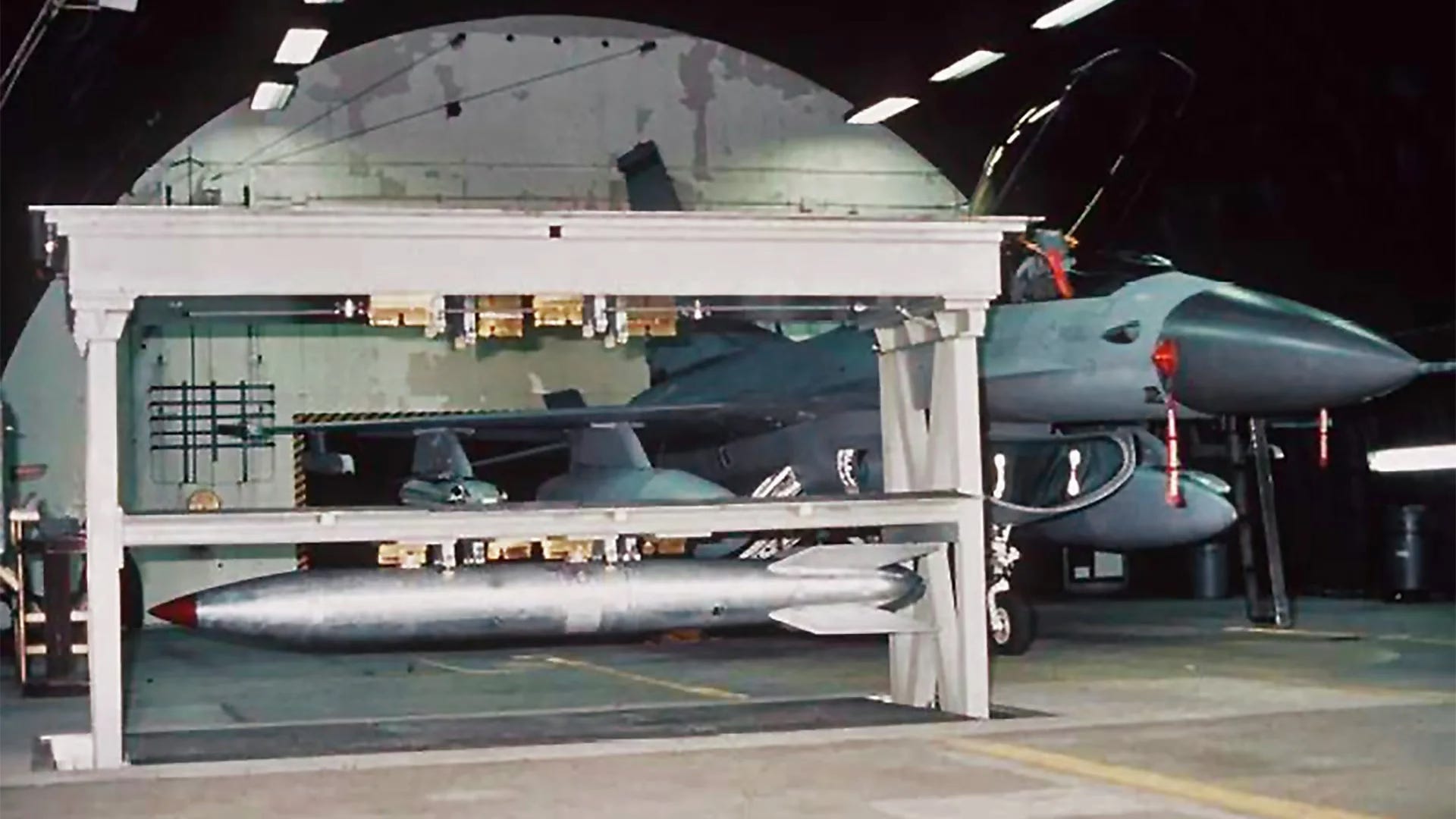
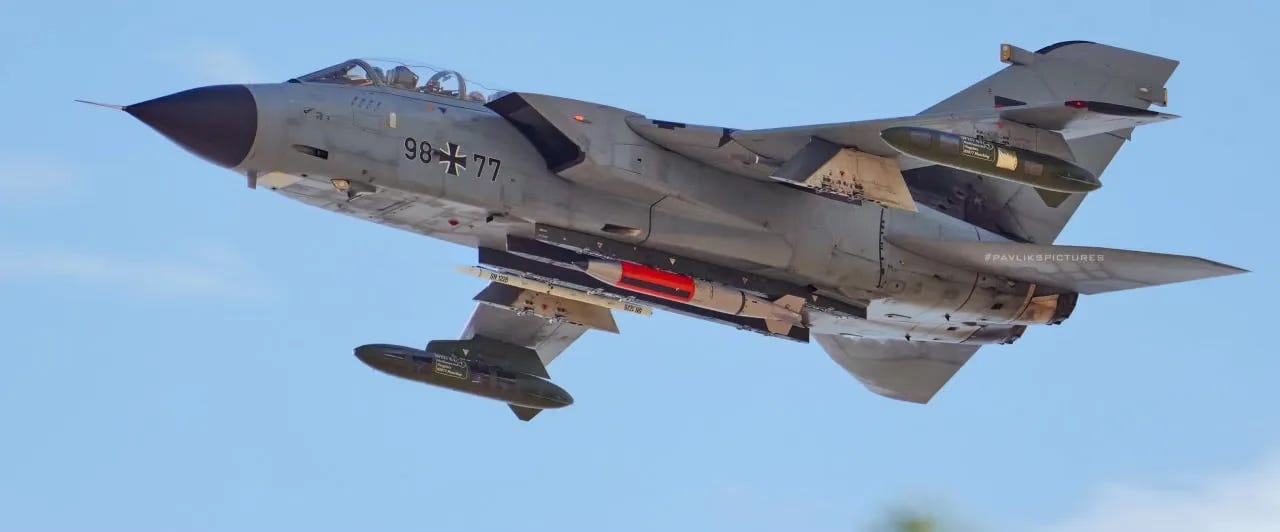
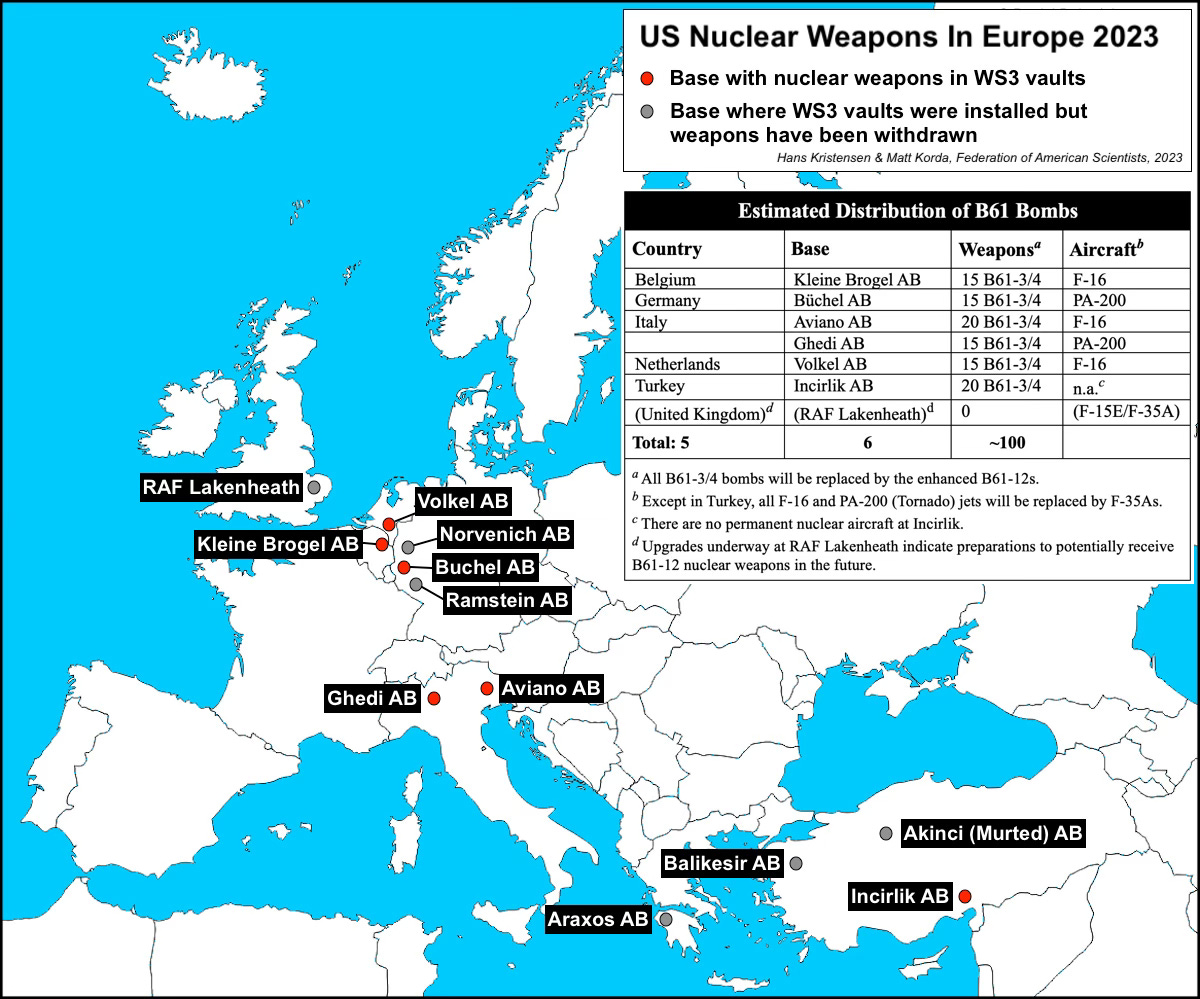
The B61 gravity bomb is a cornerstone of the United States’ “nuclear sharing” mission within NATO, representing the primary tactical nuclear weapon forward-deployed in Europe. Manufactured in the U.S., approximately 100 of these bombs are currently stored in secure underground vaults at six European air bases: Kleine Brogel (Belgium), Büchel(Germany), Aviano and Ghedi (Italy), Volkel (Netherlands), and Incirlik (Turkey). Recent reports also indicate a return of nuclear storage capabilities to RAF Lakenheath in the United Kingdom (Scientific Global Responsibility). The B61 is a “dial-a-yield” weapon, meaning its explosive force can be adjusted prior to flight; for the modernized B61-12 variant, this range spans from a “low-yield” 0.3 kilotons to a maximum of 50 kilotons (Air Force Technology). These gravity bombs are designed to be dropped by “Dual-Capable Aircraft” (DCA) operated by both the U.S. and its allies. Allied aircraft include the Belgian and Dutch F-16s, the German and Italian PA-200 Tornadoes, and the newly nuclear-certified F-35A which is being adopted by several NATO partners (Breaking Defense). The U.S. Air Force maintains its own nuclear-certified wings in Europe, primarily flying the F-15E Strike Eagle and the F-35A, ensuring that both the U.S. and host-nation pilots can execute these missions (Sandboxx).
The distribution of B61s across Belgium, the Netherlands, Germany, Italy, and Turkey reflects Cold War basing logic and modern burden‑sharing principles. These sites were selected for their proximity to potential theaters of conflict, hardened infrastructure, and political willingness to participate in nuclear sharing. Hosting B61s signals national commitment to collective defense and ensures that multiple allies share the risks and responsibilities of NATO’s nuclear posture. Modernization programs—especially the transition to the F‑35A—are designed to preserve this burden‑sharing model into the 2030s.
NATO NC2 of the B-61 Arsenal
The chain of command for a B61 nuclear release under Article V begins with the U.S. President, who holds sole authority to authorize the use of U.S. nuclear weapons. Upon a presidential decision, the order is authenticated by the Secretary of Defense and transmitted through the National Military Command Center (NMCC) to the Commander of U.S. European Command (USEUCOM), who maintains physical custody of the munitions via U.S. Munitions Support Squadrons (MUNSS). Parallel to this U.S. national “release track,” the North Atlantic Council (NAC) and Nuclear Planning Group (NPG) must provide “political approval” via consensus to authorize a NATO-sanctioned mission. These tracks converge at the Supreme Allied Commander Europe (SACEUR), who, in his dual-hatted capacity, “transfers” the weapons from U.S. custody to NATO operational control. Once SACEUR possesses both the U.S. Permissive Action Link (PAL) codes and the NATO political mandate, he issues the strike order to the specific Allied Dual-Capable Aircraft (DCA) wings. While the U.S. provides the “First Key” (the weapon and codes), the host nation provides the “Second Key” (the aircraft and pilot), effectively granting both the U.S. President and the host-nation government a mutual veto over the mission’s execution.
While USEUCOM holds operational command, U.S. Strategic Command (USSTRATCOM) serves as the “Enterprise Lead” for the mission. STRATCOM manages the Global Nuclear Command and Control System (NC3) infrastructure required to transmit the President’s Emergency Action Messages (EAM) and provides the targeting expertise and global de-confliction necessary to ensure theater B61 strikes do not interfere with strategic Triad operations. In his March 2025 testimony, the STRATCOM Commander emphasized that this relationship is critical for “executing operational plans,” providing the specialized Liaison Cells to SACEUR’s headquarters to bridge the gap between NATO theater maneuvers and U.S. global strategic posture.
NATO does not maintain standing nuclear strike plans, and there is no pre‑delegation of authority to field commanders. Any B61 employment would occur only after a political decision by the NAC and a national decision by the U.S. President. The Alliance views B61s as tools for intra‑war escalation control—intended to signal resolve, halt aggression, or prevent further deterioration of the battlefield situation. NATO deliberately avoids specifying thresholds for nuclear use, maintaining ambiguity to complicate adversary planning. This stands in contrast to U.S. strategic forces, which maintain continuously updated strike options under OPLAN 8010‑12.
Mechanics of the NC2
Release Process: The President transmits the authorization through the Emergency Action Message (EAM) system. This order is authenticated using the “Biscuit” (ID codes) and the “Football” (SOPs).
The SACEUR “Self-Transfer”: Because the SACEUR is an American officer, the transition from U.S. national control to NATO execution is seamless. As Gen. Cavoli noted in 2025 testimony, he would “pass the weapons under his command as the head of EUCOM to himself to use as SACEUR.”
Permissive Action Links (PAL): Even if a NATO ally hosts the weapons or flies the DCA, the U.S. maintains physical and technical control via PAL codes. These digital locks can only be “unlocked” by the U.S. President, preventing any unilateral use by a host nation.
Consultation Probability: While NATO policy emphasizes consultation via the NPG, the 2020 Nuclear Matters Handbook clarifies that “depending on the crisis situation, the President may consult with U.S. allies,” implying that in extreme “launch-under-attack” scenarios, the U.S. may prioritize speed over multilateral deliberation.
The Turkey Exception
Turkey hosts approximately 20 to 50 B61 nuclear gravity bombs at Incirlik Air Base. It is unique among the five nuclear-hosting NATO nations because it does not maintain a certified delivery fleet.
In a nuclear strike scenario, the chain of command for Turkey is technically “broken” at the tactical level:
No Active DCA Fleet: Since the retirement of their specialized nuclear-tasked squadrons in the late 1990s, the Turkish Air Force (TuAF) has not maintained certified F-16s for the nuclear mission.
F-35 Exclusion: Turkey was removed from the F-35 program in 2019 following its purchase of the Russian S-400 system. Unlike other hosts (Germany, Italy, Netherlands, Belgium), Turkey has no fifth-generation stealth aircraft capable of carrying the new B61-12 variant.
Custody without Delivery: As of early 2026, the weapons at Incirlik remain under the exclusive custody of the U.S. Air Force 39th Weapons System Security Group.
The “Fly-In” Requirement: Because Turkey does not fly the mission, an Article V nuclear strike originating from Turkish soil would require U.S. or other NATO aircraft (such as U.S. F-15Es from Lakenheath or Aviano) to fly into Incirlik, load the weapons, and then execute the mission.
The Unified Command Plan (UCP) Distinction
Under the U.S. Unified Command Plan, the roles are split between Geographic and Functional responsibilities:
USEUCOM (Operational Control): The Commander of USEUCOM has Operational Control (OPCON) over the theater nuclear mission. He manages the custody, storage (via MUNSS units), and the eventual “self-transfer” to his NATO-hat as SACEUR. He is the commander responsible for the specific Article V tactical execution.
USSTRATCOM (Enterprise/NC3 Lead): USSTRATCOM does not command the B61 drop, but it provides the infrastructure that makes it possible. As the “DoD NC3 Enterprise Lead,” STRATCOM manages the global Nuclear Command, Control, and Communications (NC3) network that transmits the President’s Emergency Action Message (EAM) to Cavoli’s headquarters.
Key USSTRATCOM Roles in a B61 Scenario
While USSTRATCOM is not in the direct tactical “release” chain for a B61, it is involved in three critical areas:
Planning & Targeting: USSTRATCOM manages the Joint Warfare Analysis Center (JWAC) and global targeting databases. According to the 2020 Nuclear Matters Handbook, STRATCOM provides “planning expertise to assist geographic unified commanders” (like EUCOM) to ensure that theater strikes align with broader U.S. strategic objectives and do not interfere with potential strategic Triad operations.
Global De-confliction: If SACEUR is preparing a B61 strike, STRATCOM ensures that this does not conflict with global missile defense or strategic bomber movements. In his March 2025 testimony, Gen. Cotton (STRATCOM) emphasized that the relationship with SACEUR is “important in the execution of operational plans” to maintain an integrated deterrent.
The B-52/B-21 Exception: If SACEUR requests “heavy bomber” support for a theater mission (using B61s but delivered by U.S. strategic bombers instead of Allied F-35s), the command chain involves a “support” relationship where STRATCOM provides the planes but SACEUR directs the mission.
Summary: Who “Owns” the Order?
President to USEUCOM/SACEUR: The direct operational line for theater release.
STRATCOM to NMCC: The technical line that maintains the radios, satellites, and codes used by the President to talk to USEUCOM/SACEUR.
“USSTRATCOM’s role... is not limited to nuclear plans and operations... it entails close alignment and collaboration with Geographic CCMDs.” — Gen. Anthony Cotton, 2025 Posture Statement
NC2 of the U.S. strategic triad
Strategic chain of command and NATO exclusion
In a strategic nuclear strike in the EURCOM AOR—whether using ICBMs, SLBMs, or long‑range bombers—the Supreme Allied Commander Europe (SACEUR) is entirely outside the chain of command. As outlined in the 2025 Congressional Research Service report, the strategic NC2 pathway runs directly from the President, through the Secretary of Defense, to the Commander of U.S. Strategic Command (CDRUSSTRATCOM).
Mechanics of Triad NC2
The process begins with a presidential “Decision Conference” conducted over the Secure Video Teleconference System (SVTS). During this conference, the National Military Command Center (NMCC) authenticates the President’s identity using the “Challenge/Reply” codes carried on the “Biscuit.” Once validated, CDRUSSTRATCOM selects the appropriate strike option from OPLAN 8010‑12, the digital successor to the SIOP and the foundational architecture for U.S. strategic deterrence. In this framework, even an Article V response is treated as a sovereign U.S. national mission rather than a NATO‑directed operation.
After the President’s decision, the order is transmitted as an Emergency Action Message (EAM)—a highly formatted, encrypted instruction—through the National Military Command System (NMCS). STRATCOM disseminates these EAMs directly to the three legs of the Triad: Task Force 134 (SSBNs), Task Force 214 (ICBMs), and Task Force 204 (strategic bombers. This “sole‑lead” structure stands in contrast to NATO’s dual‑key B61 arrangements; there is no transfer of authority to a multilateral body. STRATCOM retains full operational control (OPCON) of the platforms and executes the President’s selected strike package without alliance mediation.
Positive control, PALs, and launch timelines
Technical control mechanisms differ across the Triad. For the bomber leg (B‑2, B‑21, B‑52), weapons are secured by Permissive Action Links (PALs), which require a ground‑transmitted code to arm. For the submarine leg, where real‑time communication may be impossible, launch authority relies on “Positive Control” procedures: the crew must receive and independently validate a properly formatted EAM to unlock the firing sequence, as Trident missiles lack remote‑disable PALs once submerged (CRS RL33575). The system is optimized for rapid “Launch Under Attack” timelines; ICBM retaliation can be authorized in under 15 minutes. While the President has a consultative duty to allies, survivable NC3 platforms—such as the E‑4B National Airborne Operations Center—ensure the President can bypass all consultative bodies to maintain deterrent credibility.
Survivable communications and adaptive targeting
STRATCOM’s ability to execute these missions depends on survivable communications. The E‑6B TACAMO fleet provides very‑low‑frequency connectivity to submerged SSBNs using trailing wire antennas, ensuring continuity of command even if ground‑based NATO or U.S. command centers are destroyed. Through its Global Operations Center (GOC), STRATCOM manages adaptive targeting within OPLAN 8010‑12, allowing the President to modify strike options in real time as the Article V battlefield evolves.
De‑confliction with NATO operations
Because strategic launches occur outside NATO command, de‑confliction becomes a critical operational requirement. If SACEUR is conducting a conventional air campaign, incoming U.S. strategic warheads pose a risk of fratricide or misidentification. To mitigate this, a STRATCOM Liaison Cell embedded at SHAPE provides real‑time trajectory and timing data, ensuring that NATO air and missile defenses do not interfere with U.S. strategic assets and that alliance forces are not caught in blast zones. This preserves the strict separation of command while preventing inadvertent operational overlap.
Unified command plan roles
Under the Unified Command Plan (UCP), USSTRATCOM is the supported commander for all strategic missions. Geographic combatant commands—such as USEUCOM or INDOPACOM—shift to supporting roles, providing theater assessments (e.g., enemy air defenses, troop movements) but lacking authority to redirect or halt a strategic missile passing through their area of responsibility. STRATCOM also maintains the Strategic Reserve Force, ensuring that even if a NATO defense mission is underway, a portion of the Triad remains withheld to deter opportunistic aggression by other nuclear powers.
Summary: Who “owns” the order?
President → STRATCOM: The authoritative and operational line for all strategic nuclear strikes.
STRATCOM → Task Forces: Direct execution; submarines, silos, and bombers act on STRATCOM’s EAMs, not NATO’s.
STRATCOM → SHAPE: Notification only, to prevent NATO forces from being endangered by U.S. strategic trajectories.
“The President’s authority to order a strategic nuclear strike is inherent to his role as Commander in Chief... USSTRATCOM provides the survivable means to ensure that order is executed regardless of the state of the terrestrial network.” — Gen. Anthony Cotton, 2025 Senate testimony
Conclusion
A clear picture emerges from the nuclear command‑and‑control architecture described above: NATO’s deterrent posture is built around a division of labor that only functions because an American officer occupies the SACEUR role. The B61 mission depends on a dual‑key system in which the United States retains technical control of the weapons while allied governments provide the aircraft and pilots. That arrangement requires a single individual who can receive a U.S. presidential release order in one capacity and execute a NATO mission in another. The “self‑transfer” mechanism is not a procedural convenience — it is the structural hinge that allows the alliance to employ nuclear weapons at all.
At the same time, the U.S. strategic triad — the ultimate guarantee of NATO’s security — sits entirely outside alliance command. In any Article V scenario, strategic retaliation remains a sovereign U.S. decision transmitted directly from the President to U.S. Strategic Command. NATO has no authority over that process, and SACEUR has no role in it. The alliance’s nuclear posture therefore relies on two parallel systems: a multinational theater mission that requires an American SACEUR to function, and a national strategic mission that remains exclusively under U.S. control.
This is why proposals to remove the United States from the SACEUR position quickly become more than symbolic. Changing the nationality of the post would require redesigning the nuclear‑sharing system, rewriting the dual‑key framework, and creating a new mechanism for transferring custody and authority that does not currently exist. It would also force the alliance to confront a second question: if the United States steps back from the nuclear architecture it built, whose deterrent fills the gap?
France is the only NATO member with a fully sovereign nuclear force — independent warheads, independent delivery systems, independent command authority — and Paris has publicly offered to extend that deterrent to European allies. The United Kingdom, while a nuclear‑weapon state, relies on U.S. missile infrastructure and shared maintenance arrangements that limit its ability to serve as a structurally independent substitute. These issues, and the implications of France’s offer, will be examined in separate analyses.
For now, the conclusion is straightforward: NATO’s nuclear system was designed around an American SACEUR, and altering that design would require re‑engineering the core of the alliance’s deterrent posture. Understanding that architecture is the necessary first step in assessing what comes next.
Freedom Isn’t Free
The Signal Has to Spread
The analysis is mine — the amplification is yours.
If this work matters to you, help it reach the people who need it. Nothing here is backed by institutions, donors, or party machines. It spreads only because readers push it into the world — one share, one repost, one recommendation at a time.
Everything I publish is free because the stakes demand it. But independence has a cost. If you want this analysis to continue — and to cut through the noise — a paid subscription is the strongest way to amplify the signal.
And if a subscription isn’t in the cards, a one‑off tip is always welcome — caffeine and amber nectar help keep the lights on. Thank you!
Two graphics from FAS, which is extremely dated. No other sources for what is otherwise above average detail on a very sensitive subject. Very hard to attempt to read anything like this for any serious purpose. Not picking fights. Just stating my standard.