
"We know you are contemplating the use of tactical nuclear weapons in Ukraine"
It nearly happened in 2022. It is more likely to happen in 2026.

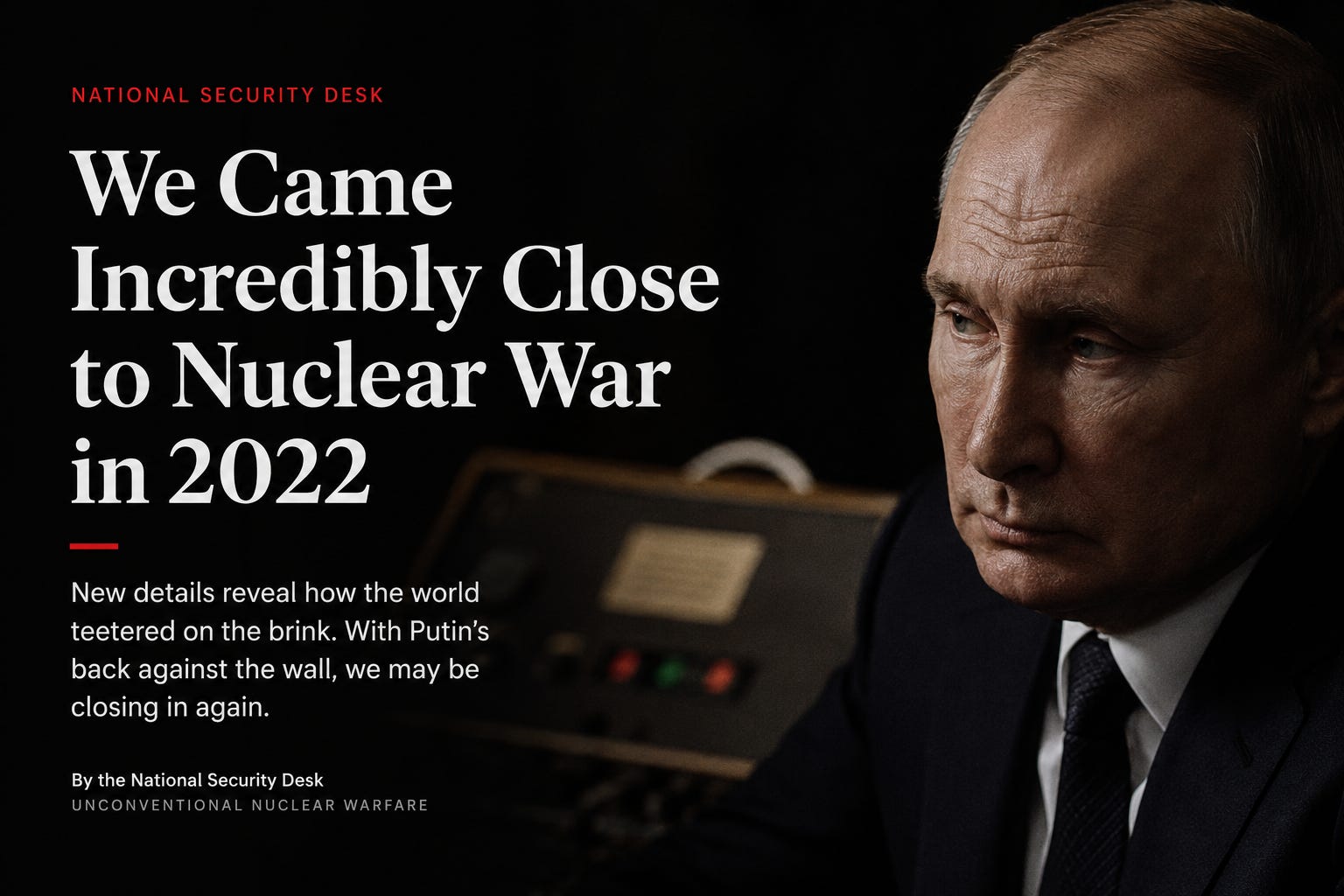
WASHINGTON DC 15 JUNE 2026
PODCAST DISCUSSION

(U) EXECUTIVE SUMMARY
The US Secretary of Defense made an urgent call to his counterpart in Moscow on October 21, 2022. Austin told Shoigu: [1]
“We know you are contemplating the use of tactical nuclear weapons in Ukraine. Any use of nuclear weapons on any scale against anybody would be seen by the United States and the world as a world-changing event. There is no scale of nuclear weapons use that we could overlook or that the world could overlook. If you did this, all the restraints that we have been operating under in Ukraine would be reconsidered. This would isolate Russia on the world stage to a degree you Russians cannot fully appreciate.”
Shoigu responded that he did not take kindly to being threatened. Austin replied:
“Mr. Minister, I am the leader of the most powerful military in the history of the world. I don’t make threats.”
Nuclear war was averted. Just. Why did the world nearly end? Thirty thousand Russian conscripts, stuck on a riverbank — just another failure in a long line of Putin’s spectacular miscalculations that led to the war in Ukraine and that continue to threaten the internal stability of Russia, and thus the survival of the Putin regime.
New signs are emerging that far more serious, regime-ending consequences are on the horizon for Putin. What does this episode tell us about how the near future might unfold? Will the endgame in Moscow bring about the end of civilization as we know it? The National Security Desk assesses that the challenge this time around may be an order of magnitude more serious — and that the United States government is unfit for the moment.
Vladimir Putin backed down. He calculated that President Biden was genuinely and completely committed to following through on that threat. Biden’s conviction to do so was only credible in the full knowledge that it would trigger the escalation ladder to general nuclear war between the United States and the heavily armed Russian Federation.
(U) SECTION I — MOSCOW? WE CAN HEAR YOU
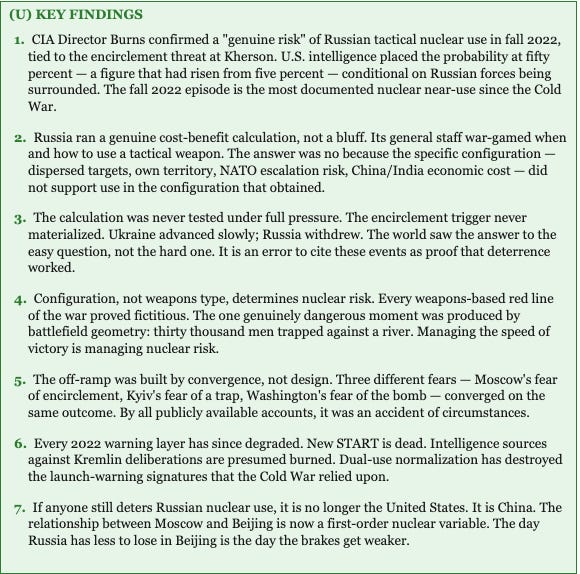
In October 2022, senior officers of the Russian military held conversations about when and how Russia might use a tactical nuclear weapon in Ukraine. Not whether to threaten one — Moscow had been doing that for months. When, and how. American intelligence was listening, and what it heard put the White House on a war footing that lasted into the winter.
Some thirty thousand Russian troops were pinned against the west bank of the Dnipro River at Kherson, their supply bridges cut, with the Ukrainian army grinding toward them — on land Putin had formally annexed into Russia three weeks earlier. If that army was encircled and destroyed, American intelligence judged the odds that Putin would reach for a nuclear weapon at fifty percent — a probability that had spiked from five percent, then ten, as the Kharkiv offensive transformed the battlefield. [2] A coin flip. Moscow feared encirclement. Kyiv feared a trap. Washington feared the bomb.
Public and official interest in nuclear weapons has atrophied since the end of the Cold War — the failure to find weapons of mass destruction in Iraq eroded what little remained — and very few people understand how close the world has come on a number of occasions. The Cold War produced near-misses the public only learned about decades later: Russia had tactical nuclear weapons on Cuba during the Cuban Missile Crisis, and Washington had no idea until it was revealed at the 1992 Havana conference. There was Stanislav Petrov, the Soviet duty officer who decided alone, on a September night in 1983, that the hundreds of American missiles appearing on his screen had to be a computer error; and the NATO exercise Able Archer, weeks afterward, which part of the Soviet leadership read as possible cover for a real first strike. But the most recent close call is not a Cold War story. It happened three and a half years ago, in the first autumn of the war in Ukraine. It is documented, named, dated, and confirmed at the highest level — and it has produced almost no reaction at all.
CIA Director William Burns confirmed it publicly in 2024: [3]
“There was a moment in the fall of 2022 when I think there was a genuine risk of a potential use of tactical nuclear weapons.”
Jim Sciutto’s reporting from senior Biden administration officials describes a White House “preparing rigorously” for a Russian strike from late summer onward; one official told him: [4]
“The fear was not just hypothetical — it was also based on some information that we picked up.”
Bob Woodward’s War reported the intelligence beneath the alarm — the fifty percent estimate, tied to the trapped army at Kherson. [2] The RAND Corporation has studied why Putin held back. Ulrich Kühn has published the only peer-reviewed study of the episode. [5] George Perkovich of the Carnegie Endowment, grading every Russian nuclear threat of the war against a formal assessment framework, found exactly one that qualified as urgent: September–October 2022. [6]
None of this is secret; it is simply unabsorbed. NSD wrote the warnings in 2022, and yet the volume of recent official confirmations surprised even NSD. There was no moment of reckoning to miss. The confirmations arrived one at a time — a CIA director’s aside in 2024, a Woodward book that October, a journal article in 2025, a Carnegie study in 2026 — and each landed without an echo, into a news environment too overwhelmed with noise and manufactured urgency to notice. In place of a reckoning, a comforting story took hold, and it rests on two claims. The first: it was always a bluff. The second: it didn’t happen because it can’t happen — the nuclear taboo held. Both claims hold the comfortable story up. Both are wrong about what actually occurred.
Russia’s invasion had stumbled from its first week, but in September 2022 it began to collapse. Ukraine’s counteroffensive at Kharkiv routed the Russian army across thousands of square kilometers in days. On 21 September, Putin announced mobilization and delivered the most explicit nuclear threat of the war: [7]
“When the territorial integrity of our country is threatened, we will certainly use all the means at our disposal to protect Russia and our people. This is not a bluff.”
Nine days later he built the trap door beneath those words, formally annexing four Ukrainian regions into the Russian Federation. The significance was legal, not ceremonial. Territory Ukraine was actively liberating was now, on paper, Russia — and Russian doctrine reserves nuclear weapons for threats to Russia itself. Putin had wired his own red line to a battlefield he was losing.
The battlefield then closed in on the wire. Kherson was the only regional capital Russia had captured in the entire war, annexed three weeks before, and the thirty thousand men defending it were trapped against a kilometer-wide river with their crossings under fire. Inside Russia the pressure to escalate was open and loud — when the town of Lyman fell on 1 October, the Chechen warlord Kadyrov publicly demanded the use of a low-yield nuclear weapon. [8] Washington’s alarm broke into public view on 6 October, when President Biden told a New York fundraiser: [9]
“We have not faced the prospect of Armageddon since Kennedy and the Cuban Missile Crisis.”
Under a conventional presidency, a statement of that weight from a sitting American president on nuclear matters is itself a signal — one that analysts who have spent careers reading presidential language know how to interpret. Presidents do not invoke Armageddon casually, or should not. The precision of presidential language on nuclear questions is — or should be — the most carefully calibrated communication in public life, because its audience is not only the American public but every government with a stake in what Washington will and will not do. A president who uses the word in public has decided the cost of saying it is less than the cost of silence. That calculation was real in October 2022. The current administration’s approach to public communication — where the most inflammatory, self-contradicting, and evidently false statements are made as a matter of daily routine — has badly eroded exactly that signal discipline. When Washington says something nuclear, the world has been trained to treat it as noise. The United States has created for itself precisely the boy-who-cried-wolf problem that Russia created with 135 empty threats: serial bluster that destroys the audience’s capacity to recognize the genuine signal when it arrives. That erosion is a security cost that cannot be easily calculated, and it is not unconnected from the personal relationship between the current American president and the man in the Kremlin. Biden’s October 2022 warning was the genuine article. It deserves to be read as what it was.
Behind the scenes the machinery was already running. Austin placed the call to Shoigu, the transcript of which opens this essay. [1] The chairman of the Joint Chiefs spoke to the chief of the Russian General Staff days later. The national security adviser worked quiet channels into the Kremlin that had been kept open for exactly this moment. Washington widened the information campaign, enlisting the two capitals Moscow could not afford to ignore. India’s Prime Minister Modi had already told Putin to his face in September: “Today’s era is not an era of war.” [10] India’s defense minister told Moscow directly — on a call the Russians themselves had requested — that nuclear weapons must not be used. China’s Xi Jinping said the same in public in early November. At the G20 in Bali on 16 November, the major powers declared, with Russia’s own signature attached, that “the use or threat of use of nuclear weapons is inadmissible.” [11]
(U) SECTION II — THE BIDEN REVELATION
In the weeks before the invasion, the Biden White House did something governments never do: it published highly classified intelligence — telling the world that Russia was preparing fake atrocities and staged attacks as pretexts for war. The disclosures most likely cost real sources and methods, and they gutted the false-flag playbook before it could run. In late October 2022 the same play appeared again: Russian officials phoned four Western capitals claiming Ukraine was about to detonate a radiological “dirty bomb” — the classic shape of a pretext under construction — and Washington and its allies called it out publicly within hours. The claim died on the table; nothing ever went off. Then, on 2 November, came the boldest disclosure of all. The New York Times, sourced to U.S. officials, revealed the intelligence that had driven the autumn’s alarm: senior Russian military officers had discussed when and how a tactical nuclear weapon might be used. Understand what that disclosure cost. The ability to hear nuclear deliberations inside the Kremlin is among the crown jewels of American intelligence — the most precious intelligence a nation can possess, the kind that takes decades to build and one leak to destroy. Governments do not spend the crown jewels on a bluff. Spending them was itself evidence of how serious the moment was, and it was also a message, aimed straight at Moscow: we can hear you. Deterrence only works where it can be seen — it is why American nuclear forces do so much of their business in the open, with announced bomber flights, test ICBM launches, publicized exercises and submarines surfacing in foreign ports. The leak applied that old principle to intelligence itself.
By then the crisis had already crested. On 27 October, Putin told the Valdai Discussion Club — his annual international forum for signaling Russia’s strategic position to a curated audience of foreign analysts, academics, and officials — that there was “no need” for nuclear weapons in Ukraine: [12]
“There is no sense in it, neither political nor military.”
For a dictator who has built his entire political persona on the projection of uncompromising strength, delivering a public nuclear stand-down from his most prestigious platform was a significant loss of face — the kind that any autocrat, but Putin in particular, would have felt keenly. To say there is “no sense” in using the weapons he had been threatening for months was to confirm that he had been threatening them. For all Moscow’s lack of nuclear signal discipline — the 135 empty threats that had destroyed its credibility — this rare instance of precise, deliberate communication from Putin himself carried exactly the weight that serial bluffing had squandered. The climb-down was under way. The audience was not the academics in the room. It was Washington and its allies, who had been waiting to see whether the pressure campaign had worked.
On 9 November, Russia announced the withdrawal of its entire force from the west bank of the Dnipro. Over three nights, thirty thousand men crossed the river. The encirclement — the condition attached to the use of nuclear weapons — never happened. The CIA director flew to Ankara five days later to tell his Russian counterpart, face to face, what would follow any future use. The most dangerous nuclear episode in sixty years ended without most of the world ever noticing it had begun.
(U) SECTION III — BLUFFS ARE A PATHWAY TO ARMAGEDDON
Weak and scared after it lost the Cold War, Russia has turned to the only threat it had left once its conventional military withered from 1991 onwards. The National Security Desk catalogue, Russian Nuclear Threats 1999–2025, [13] runs to 111 entries from Yeltsin’s first warning onward, under a subtitle that states the finding: zero credibility. By VOA’s count, top Russian officials issued 135 nuclear-related statements between February 2022 and December 2024 alone. [14] A saber rattled that often stops advertising resolve and starts advertising weakness. All of that is true — and it is exactly why the fall of 2022 is so dangerous to misread. This is the boy who cried wolf, played out at planetary stakes. When everything is a threat and nothing happens, people lose the ability to notice when the danger is real. The fall of 2022 was the wolf. Filing the one genuine episode back under “bluff” is precisely the mistake the fable exists to warn against.
The profession of arms is one of the most specialized of all human endeavors. The profession of nuclear arms sits in a class of its own beyond that — a discipline whose logic is so counter-intuitive, so discontinuous from conventional military thinking, that it must be taught and practiced as a distinct body of knowledge. Nuclear deterrence does not work like conventional coercion. It does not reward aggression; it rewards credibility. Its central mechanism is the adversary’s belief — in your willingness to act — and that belief, once eroded, is nearly impossible to rebuild. This is what Russia destroyed with 135 threats and zero follow-through. An adversary who has watched every red line crossed without consequence has learned, correctly, to discount the next threat — and will go on discounting them. A power that bluffs its way through a hundred crises has spent the only currency that actually matters. One of the core arguments of this essay, and of NSD’s work in the unconventional nuclear warfare domain more broadly, is that the institutional knowledge required to think clearly about nuclear deterrence has atrophied badly in the West since the Cold War. The result is exactly what the record above shows: an establishment that reached reflexively for conventional military judgment in a nuclear situation and, in doing so, almost failed to notice when the danger was real.
Resting all hope on the nuclear taboo is even more dangerous. Taboos do not get war-gamed by general staffs. What separates the fall of 2022 from the surrounding theater is that it left fingerprints: actual officers, in actual meetings, working through the when and the how. You do not convene that meeting about something unthinkable. You convene it about something you are thinking about. American intelligence was eavesdropping on Russian commanders. Leaks to the press about this episode — again the Biden technique — took pains to note that Putin was absent from the collected conversations. Generals do not freelance on the most dangerous question in the country; men who do have a way of falling out of open windows. The far more believable explanation is that the General Staff was doing exactly what it believed the boss wanted: running the options, below the president, who would only be brought in at the moment of decision, with his name kept off the record until then. That is how the Russian system is built to operate. Both Washington and Moscow had compelling reasons — different in origin, identical in effect — to keep Putin’s name away from the deliberations in the telling, and understanding why is central to understanding how President Biden managed the crisis. Publicly naming Putin as the man weighing nuclear use would have cornered the president and burned the off-ramp the whole strategy depended on. The leak said we can hear you, and saying it to the generals was safer than saying it to the dictator. Moscow needed the distance to preserve the option of climbing down, which is what it ultimately did. Every one of those readings is more credible than frustrated generals gaming Armageddon behind the dictator’s back — which is exactly what conventional analysis lazily assumed to be the case.
The fall of 2022 was a real-world nuclear combat decision.
Russia did not hold back because the threat was hollow, and it did not hold back because a moral firewall stopped it. It held back because the costs and benefits were weighed, in the circumstances that actually existed, and the answer was no. A nuclear strike could not fix the front: Ukrainian forces were advancing spread out, offering no massed target, and the blast would have fallen on land Moscow had just written into its own constitution as Russia. It risked bringing NATO directly into the war — which meant either Russia’s defeat and Putin’s fall, or escalation into Mutually Assured Destruction. China and India, the two economic lifelines keeping the sanctioned war machine afloat, publicly warned Moscow not to use its weapons. Putin’s own Valdai statement was not the language of taboo - but of cold calculation — an assessment of whether the weapon would actually achieve anything, not a statement of moral scruple. And it was delivered from a stage designed to be heard. Any leader of his type would have felt the weight of saying those words in public. That he said them at all is the measure of how seriously he weighed what would have followed if he had not.
Nearly this entire record runs through American officials — Burns, Woodward, the November leak to the New York Times — and those officials themselves disagreed over whether the intercepted talk was real intent or routine contingency work. Or perhaps that was their cover for revealing it. What is not in doubt is the response of the world beyond Washington. The warnings came from American intelligence. The response came from Xi and Modi speaking out against nuclear use. That convergence of independent actors is the answer to anyone who suspects Washington had simply frightened itself.
(U) SECTION IV — OPERATION VULTURE
The pattern has a precedent. In the spring of 1954, French forces besieged at Dien Bien Phu appealed to Washington for intervention. The Eisenhower administration gave the request serious consideration. The planning that emerged — codenamed Operation Vulture — included the option of tactical nuclear weapons against Viet Minh artillery positions surrounding the valley. [15] The concept reached the National Security Council. The conclusion Eisenhower and his advisers reached was straightforward: a nuclear strike would not work. The geography was all wrong — Dien Bien Phu sat in a narrow mountain valley, the enemy artillery was spread across surrounding ridgelines, French troops were intermingled with the very positions that would need to be destroyed. A weapon dropped there could not deliver a decisive military result; it would kill French soldiers and level the valley, but it would not save the garrison. The political cost of being the first nation to use nuclear weapons since Hiroshima was incalculable. The British refused to participate in any intervention, removing the cover of allied consensus. President Eisenhower decided against action. Dien Bien Phu fell in May 1954 without American intervention. The nuclear option had been considered at the highest levels — and set aside, not on moral grounds, but because it would not have worked. The same reasoning that said no in a valley in Indochina in 1954 said no again at Kherson in 2022. The situations were different. The conclusion was the same.
That verdict was partly a verdict of technology. The nuclear weapons of 1954 were blunt instruments — fixed yield, no terrain navigation, blast radii that could not distinguish enemy artillery on a ridgeline from allied troops in the valley below. The geometry that defeated the nuclear option at Dien Bien Phu was a problem those weapons simply could not solve. Today, two developments have moved simultaneously in opposite directions. Modern nuclear weapons have acquired the precision that 1954 lacked — dial-a-yield warheads, terrain-following delivery, approach azimuths selectable by the planner. But modern conventional precision weapons have also acquired the capability to achieve the same tactical result without going nuclear at all. Today’s Dien Bien Phu gets a conventional solution. Had 1954 possessed today’s nuclear precision without today’s conventional alternatives, the valley calculation might have returned a different answer.
There are a small range of strategic conditions that make the use of tactical weapons plausible. For example, to target Usama bin Laden in Tora Bora. A remote steep mountain range in the Hindu Kush, far from any population centers, and undefended by any nuclear power’s promise of extended deterrence. The use of an ICBM is out. The arc of travel of an ICBM launched from the United States at Afghanistan would look to both Russia and China as a sneak attack. Nor can the terminal flight path of an ICBM negotiate contours of mountain ranges changing its approach characteristics. An AGM-86B overcomes all those limitations. A nuclear armed air launched cruise missile, with a dial-a-yield warhead (5 kt to 150kt), used against targets in a valley of steep hard rock, flying in at a particular azimuth and detonated at a certain height above ground, would eviscerate anyone hiding in tunnels in those mountains without generating fallout. Bin Laden arrived in Tora Bora about ten weeks after 9/11. This was the absolute apex of global support for the US and considerable fear in many capitals that had offered permissible environments for al Qaeda. Nuclear use in this context was called for. Not only would it have killed UBL it would have signaled to all that the US would not tolerate any gamesmanship from any actor on the world stage. Instead, UBL became a shining light and inspiration to every bad actor anywhere for evading the might of the United States. All the copycat terror groups and their state sponsors that sprung up all over the world in the decades after 9/11 would have remained silent in abject fear had UBL been killed hiding in his cave.
(U) SECTION V — KHERSON WAS NOT A SUFFICIENT TEST
The Kherson calculation was never run under full pressure. First, Kherson had none of Tora Bora’s enabling conditions: no remote terrain channeling and concentrating the detonation, no single isolated target set, no hard rock geology amplifying the effect, no absence of a nuclear power’s extended deterrence commitment over the target — and critically, land Moscow had just written into its own constitution as Russia. Second, the risk was conditional — if the encirclement came. It never came. Ukraine advanced slowly; Russia withdrew in good order; and the moment the west bank emptied, the one scenario in which a nuclear weapon bought Russia anything ceased to exist. One senior U.S. official described the threshold in almost clinical terms: [16]
“If significant numbers of Russian forces were overrun — if their lives were shattered as such — that was a sort of precursor to a potential threat directly to Russian territory or the Russian state.”
The world never saw the answer to the hard question. It saw the answer to the easy one because the operational crisis was managed. The Russians escaped the trap. Accordingly, it is an error to cite these events as proof that deterrence worked.
The successful retreat nullified the nuclear option — it was not proof of Russian nuclear restraint. Offered the choice between losing Kherson slowly with the army intact or losing it catastrophically and facing the nuclear question, the system paid in territory to make the question disappear. The officer who announced it on state television, in a staged exchange with the defense minister, was General Sergei Surovikin — known as “General Armageddon” for his record of ferocious conduct in Syria and Chechnya. The nickname earned by destruction served, on this occasion, to prevent it: Surovikin’s recommendation to withdraw for purely military reasons removed the very trigger condition that could have forced the nuclear question. The man named for Armageddon, acting on logistics, kept the world from it. The west bank of the river had been doomed since summer, when Ukrainian rockets cut the river crossings, so withdrawal could be presented inside the regime as military necessity rather than a nuclear flinch.
Off-ramps work when they come with cover stories. And the cover story was built collectively, by parties who never coordinated. There is no evidence of a secret deal to let the Russians escape. Moscow feared encirclement. Kyiv feared a trap. Washington feared the bomb. US–Ukrainian joint war-gaming that summer had talked Kyiv down from a grand southern offensive into the narrow push on Kherson; Washington withheld long-range missiles and deep-targeting intelligence precisely because it feared where deep strikes might lead; Ukrainian commanders, suspecting the announced withdrawal was bait for an ambush, advanced carefully and said so on the record. Three different fears converged on the same outcome: thirty thousand men crossing a river, largely unmolested, over three nights. Sun Tzu’s golden bridge was built by convergence — which is the more unsettling conclusion, because it means the most important nuclear off-ramp of the war was under no one’s control. By all publicly available accounts, it appears to have been an accident of circumstances. Had the Russians failed to retreat in time — had the Ukrainians advanced just a bit faster — the decision point would have arrived, and the answer could have been different.
The deepest Western error of the war was an obsession with not provoking Putin with new or longer-ranged weapons. Would ATACMS, then Storm Shadow, then F-16s provoke Moscow? Every weapons-based red line turned out to be fiction, while the one genuinely dangerous moment of the war was produced by something nobody was arguing about: the shape of the battle itself. A surrounded army, not a missile type. Weapons-based red lines were bluffs because no weapon changed Russia’s arithmetic. The situation on the ground is the arithmetic. The cautious officials who rationed hardware and the hawks who said the caution was all self-imposed were arguing about the wrong thing. How you win shapes whether the loser goes nuclear. Managing the speed of victory is managing the risk of nuclear war. Any future campaign built to rapidly annihilate the army of a nuclear power should sit with that sentence for a long moment.
Restraint was a calculated decision that could have gone the other way had the circumstances been different.
If the bomb stayed in the silo because the math said so, then the restraint was conditional, not permanent. Change the conditions — a battlefield where a nuclear strike does buy a decisive result, an adversary whose foreign backing has dried up, a regime that no longer has China and India to lose — and the same rational actor, running the same process, returns a different answer. The 2022 answer was no only because Russia still had things it could not afford to lose. That matters, because those things have been slipping ever since.
(U) SECTION VI — THE RECORD IN REAL TIME
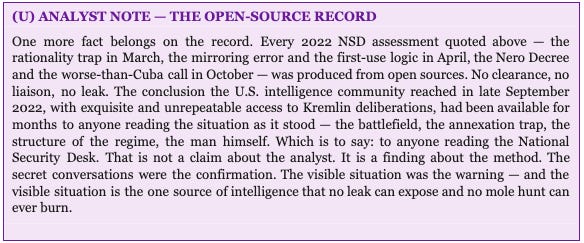
The National Security Desk did not assemble this picture in hindsight, as the timestamps prove.
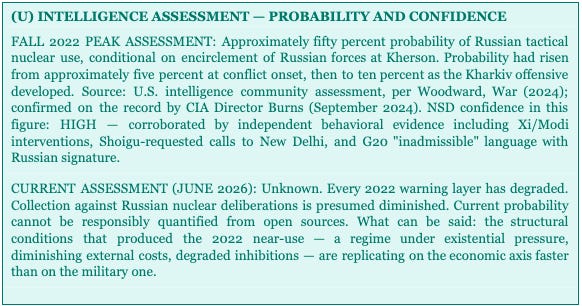
MAD MAN! [17] was published on 30 March 2022, five weeks into the war and six months before the peak of the crisis. It was the first thing Unconventional Nuclear Warfare (UNW) ever published — the page itself was only two days old, created because events were demanding a place to say what follows. The argument: Putin is not mad but logically wrong, and that is the more dangerous diagnosis. A madman might be unreachable; a rational actor is reachable by logic right up to the moment the logic flips. The question that piece put on the table was the one the field then spent a year not asking: when a rational, cornered leader has nothing left but nuclear weapons, when does it become rational to use them — when does the calculation shift from “winning” to “not losing everything”?
Three weeks later, Tactical Nuke on Kyiv [18] (20 April 2022) laid out the logic of first use below the threshold that triggers mutually assured destruction: the side that fires a single tactical weapon hands the agonizing choice to the other side, which must pick between a weak conventional reply that invites more use and a nuclear reply that opens the road to general war.
Gen. Barry McCaffrey — a retired four-star and one of the most serious military voices in American public life, speaking here for what was then the entire Western consensus — replied to NSD: [19]
“Utter madness. Illogical. The use of any nuclear weapon by Russia invites a dreadful escalation. Russia would not survive a nuclear exchange they initiated. Putin’s survival at stake… not Russia. Would he create Armageddon as his final act. The Russian political and military elites need to step up to this.”
NSD’s answer, in the thread, in April 2022:
“It might be mad and illogical to you. But you are not Putin.”
That exchange deserves careful reading — not as social media provocation, but as a serious exchange between people who understood exactly what they were discussing and what was at stake. In the national security world, particularly under the pressure of a live nuclear crisis, people who have spent careers on these problems communicate with a bluntness that can read as bruising in other contexts. Neither McCaffrey’s verdict nor NSD’s reply was reckless. Both were serious. McCaffrey was not refusing to think — his comment runs a real argument, and its final sentence even reaches for the same brake this essay arrives at below: the men around Putin. But his argument rests on a hidden assumption: that any nuclear use, however small, triggers the full MAD exchange. NSD’s position was that a single battlefield weapon was below the threshold that triggers general nuclear war — and that the side that fires first hands the impossible choice to its opponent. That was the real disagreement. Not analysis against reflex — but a genuine dispute about how deterrence actually operates when the question is a single low-yield bomb rather than an intercontinental missile. The two-word verdict still matters, though, because the reflex it expresses — illogical, therefore not worth thinking through — is what kept the West, for one crucial season, from working out the very scenario its opponent was actively working through. NSD named the mechanism that April: fatal cultural mirroring. We find the option unimaginable, so we assume he must too. But what if he has nothing left to lose? Would Hitler, shaking and sweating in his bunker in Berlin, encircled by Russian forces, have taken others with him if he could?
The autumn then settled the exchange. On the analysis, the record vindicates NSD: the Kremlin’s own staff war-gamed when and how to use the weapon. An option that a general staff war-games has, by definition, been taken seriously. It was considered — and rejected — on cost. Not morality. That is the opposite of illogical. It is a calculation that happened to return: no. On the outcome, the record is just as plain: he did not use it, and McCaffrey’s bottom line held. But look at why it held. Washington spent the autumn making his assumption true by force of effort — Austin’s devastating call with Shoigu, the calls between the generals, the quiet channels, Burns to Ankara, Xi and Modi enlisted, the G20 mobilized. Along the way the US improvised something it had never offered a country outside its alliances: a private, unwritten shadow of the American nuclear umbrella, extended over Ukraine, deliberately vague about means but unmistakable in meaning — use it, and you answer to us. It was extended deterrence — the offer of a nuclear shield to a country that is not a formal treaty ally — it is hard to know what else to call it. The conclusion that nuclear use would be suicidal for Russia was not a fact of nature. It was manufactured, week by week, by the most intensive nuclear crisis management since 1962. The fact Putin didn’t use it tells you what the answer was in those circumstances. It tells you nothing about what the answer will be next time. If Putin contemplated nuclear use to save 30,000 troops, how much further would his thought train go if he was contemplating his own survival?
By late October the president of the United States was invoking Armageddon at a public event. NSD published a new assessment on 30 October that went further than President Biden’s warning. The risk of intentional nuclear use, it assessed, was now higher than during the Cuban Missile Crisis. It put the reasons in writing, inside the window, for anyone to check. This was three days after Putin’s Valdai climbdown, and ten days before the withdrawal ended the danger.
NSD’s open-source analysis aligned with warnings emerging from the very top of America’s nuclear chain of command, inside the window, in plain language. On 2 November 2022 — the same day the Times story broke — Adm. Charles Richard, the commander of U.S. Strategic Command and the officer responsible for the nation’s nuclear forces, told the Naval Submarine League symposium: [20]
“This Ukraine crisis that we’re in right now, this is just the warmup. The big one is coming. And it isn’t going to be very long before we’re going to get tested in ways that we haven’t been tested in a long time.”
He continued: the current situation “is vividly illuminating what nuclear coercion looks like — and how you do, or how you don’t, stand up to that.” NSD first met Admiral Richard in 2014 when he was a two-star. He stood out among his peers for his penetrating intellect and carefully calibrated imagination. The fact he went this far in a public setting is stunning and is understood by NSD for what it is - the public equivalent of the 3AM call to the White House Situation Room.
Richard was not narrating Kremlin deliberations. He was a commander weeks from handing over his post, with no career left to protect, spending his last public moments on a warning — not that the taboo would hold, but that there was a serious chance it would not. It was the first such warning from an officer of that seniority since the Able Archer crisis of 1983.
(U) SECTION VII — THE THRESHOLD
So what, exactly, is the threshold? The fall of 2022 goes a long way toward answering that question — but not in the direction the “cornered and still said no” reading suggests. His back was against the wall. Kharkiv was a rout; Kherson was falling; annexed land was being retaken; his own mobilization was destabilizing the home front. He was cornered. And the deliberations were real — the intelligence was solid enough to put the White House on a months-long war footing. Being cornered was necessary. The evidence suggests it came close to being sufficient.
What stopped him was not the inadequacy of the pressure. It was the construction of an exit. As the preceding account makes plain — the war-gaming, the withheld systems, the Ukrainian caution that gave the army a road home, the cover story of military necessity — Washington had spent the autumn doing something more than threatening consequences. It had been building a way out. The logic that has guided every serious nuclear crisis manager from Kennedy onward is the same: you cannot apply maximum pressure to a nuclear adversary without simultaneously providing a viable exit. Pressure without exit is suicide by one remove. The door is what stopped Putin at the threshold. Remove the door and the answer changes.
(U) SECTION VIII — A SECOND PRECIPICE
This matters urgently, because Putin is approaching a second precipice — and this time there may be no door. The threat he faces now is not the encirclement of his army but the survival of his regime. Russia’s National Wealth Fund, the sovereign reserve that has financed the war, is being liquidated at a rate that will exhaust its liquid assets within months. The fund’s gold holdings have fallen from 405 tonnes before the invasion to 173 tonnes; in November 2025 alone, Moscow shipped $961 million in physical gold bars to China to settle accounts. [21] Oil and gas revenues — representing up to half of state income — were down more than a quarter year-on-year. This got a brief reprieve from the American miscalculation in Iran that sent oil prices higher but that is still not enough to reverse the trendline for Putin. The interest rate required to prevent currency collapse stands at 16 percent. Import costs for strategic goods have surged 122 percent. Analysts project the remaining liquid reserves will be exhausted within twelve months at current burn rates.
Inside Russia, the political atmosphere is shifting in ways that the financial data alone does not capture. A May 2026 analysis by a former senior Russian official [22] describes a language shift among the Kremlin’s extended circle: senior officials, regional governors, and businessmen have stopped speaking of the war in the first-person plural. It was “our” project. It has become “his.” Not our war. Not our agenda. But the author identifies something more consequential than a change of pronoun. The regime, the analysis notes, still has a monopoly on violence — but has lost its monopoly on shaping the future. Every previous version of the system came with a project: “sovereign democracy,” “energy superpower,” a national vocation. Something to sell, something to believe. That is gone. In its place, Putin’s decisions have begun to be experienced by those around him “as something that will unfold independently of him — and possibly already without him.” For the first time since the invasion began, Russia’s elite is starting to imagine a future that does not include Putin — not from opposition but from self-preservation. In the past three years, the country has undergone its largest redistribution of property since the privatizations of the 1990s, with business assets confiscated and handed to loyalists and cronies. The author’s point is stark: deep loyalty and silence are no guarantee of safety, because confiscation follows its own logic. The apparatus that might, in another scenario, refuse a final order has watched its own property change hands. The system has reached what chess players call Zugzwang: every move Putin makes to preserve his position accelerates the decay he is trying to prevent. He cannot win outright. He cannot afford to lose. And unlike Kherson, there is no army to withdraw and no river to withdraw across. The pressure building now has no military off-ramp. “He can only,” the author concludes, “make the regime bloodier and more dangerous.”
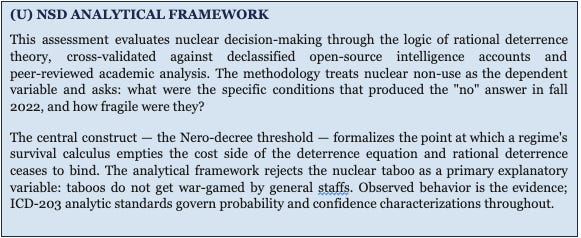
As the voice from inside the Kremlin makes clear, the real threshold is narrower, and NSD first put a name to it inside the window itself. On 30 October 2022, NSD drew the parallel with Hitler’s Nero Decree. In March 1945, Hitler gave the order to destroy what remained of Germany — to deny the Allies anything of value, and to punish the German people for “failing him”. In his telling, they were to blame for the collapse of the thousand-year Reich in just twelve years. The only remaining brake on Hitler’s plan was his inner circle. That 2022 insight, sharpened into a condition, is the Nero-decree threshold: the point at which a regime concludes that its own survival is already forfeit — that it loses no matter what it does. That conclusion is what empties the cost side of the calculation. Deterrence works by holding at risk something the other side values; if the leadership believes everything it values is already gone, there is nothing left to threaten. The very things that produced Russia’s “no” in 2022 — China, India, the avoidance of war with NATO, the survival of the regime itself — only count as costs while the regime still believes it has them to lose.
But the threshold has two gates to take full effect. Hitler’s Nero Decree was issued. But it did not pass the second gate. It was ignored. Albert Speer and key military leaders worked around it, because the men of the apparatus still had futures to protect even when their leader did not. The apparatus always has a future even when the leader does not. That gap sits at the heart of every end-of-regime scenario, and it is why a truly collective everything-is-lost conclusion is nearly impossible to reach. Gate one is the leader’s conclusion. Gate two is whether the system obeys. The fall of 2022 and the spring of 1945 are mirror images of the same lesson — in 2022 the officers deliberated below the leader; in 1945 the leader decided and the officers refused — and in both cases the idea of the state as a single mind failed exactly where it mattered most. So the signal to watch is not collective despair. It is the leader welding the second gate shut: launch authority handed down in advance to loyalists, weapons custody broken up among true believers, obedience built into the chain so that refusal is no longer possible. Of course the circumstances have to be right for the second gate to resist. When Stalin died, no one dared enter his room due to a standing order not to disturb his sleep. Anyone ignoring Putin even at the end will be shot.
(U) SECTION IX — CALCULATION, NOT A NUCLEAR TABOO
What this essay has established is that nuclear use is prevented not by moral inhibition or an inherent taboo but by a calculation that depends on specific, observable conditions. That makes nuclear crisis management an intelligence problem as much as a diplomatic one — and intelligence needs to know what those conditions look like when they begin to change. One report in the existing record has never received the scrutiny it deserves.
Woodward’s War contains a single-sourced account that Putin actually weakened operational control over Russia’s nuclear weapons in 2022 — not to ensure restraint, but to ease the path to use. [23] The same book contains a direct quote from Biden himself, given privately to his national security adviser as the crisis peaked: [24]
“Putin is not going to let himself be routed out of Ukraine without breaking the seal on tactical nuclear weapons. So, we are stuck.”
NSD’s assessment, drawn from reading his reporting across administrations, is that he has not been found substantively wrong on material facts. More relevant to this specific claim: for his Ukraine reporting he obtained, and read publicly from, the actual transcript of the Austin-Shoigu call — a transcript that Secretary Austin himself subsequently confirmed as accurate. A reporter who operates at that level of documentation and verification does not invent an explosive claim about a foreign leader’s modification of nuclear command and control for the sake of a headline. He has far more to lose from being wrong than he has to gain from being first. The “weakened operational control” account remains uncorroborated and runs against everything publicly known about how tightly Russia holds its launch authority. But “uncorroborated” is not the same as “invented,” and the analytical weight here, given the source, is not low.
This is exactly what intelligence needs to be watching for. The following indicators follow from this analysis:
• Deliberations moving upward: The leader in the room is the signal; staff-level gaming is the noise the system correctly read in 2022.
• Changes to custody and command: Watch for restructuring of launch authority — the welding of the second gate.
• Beijing and New Delhi stepping back: A Russia spending those lifelines is a Russia running out of things to lose. But watch equally for Beijing and New Delhi making their own decision to distance themselves from Moscow — something Russia does not control, and which would remove the most powerful external restraint without warning. If China and India pull away of their own accord, the Nero-decree threshold approaches from a direction the Kremlin cannot manage.
• The abandonment of channels: Watch for the channels Russia once valued falling silent — for irregularities around the succession, for the families of the elite quietly in motion, and for nothing-left-to-lose talk from the leader himself — not from the television propagandists, who have nothing to lose nightly.
• The silence of the physical world: Pay attention to the silence, because in 2022 the silence was the strongest evidence there was: no warhead left central storage, nothing was mounted on a missile, no alert level changed. The physical world stayed quiet all autumn.
A final caveat on this watch list, because it matters: every indicator above depends on intelligence of sufficient quality, coverage, and timeliness to be believed and acted on. The 2022 alarm was successful because penetration of Russian deliberations was deep, the collection was timely, and the decision chain that received it trusted itself at every link. In 2026, none of those three conditions can be assumed. The OODA loop — the cycle of observation, orientation, decision, and action — must close faster than events develop. History suggests it often does not. The causal chain from warning to action is long, and every link in it is fragile.
(U) SECTION X — THE WARNING SYSTEM IN 2026
The day the metal moves, everything changes. The question is whether anyone would see it move. Because everything that produced the “no” of 2022 has been eroding since.
Information channels are dying. New START — the last treaty limiting U.S. and Russian strategic weapons — expired on 5 February 2026 with nothing to replace it, its inspections already three years dead, and the quiet lines that carried Austin’s and Burns’s warnings are thinner than at any point since the early Cold War. The threats themselves have gone cheap: Russia’s through four years of crying wolf. Russia formally lowered the bar in its written nuclear doctrine in November 2024.
The most dangerous change of all has gone almost entirely unremarked.
Russia’s missile arsenal is largely dual-use — the same Iskanders, Kalibrs, and Kinzhals are built to carry either a conventional warhead or a nuclear one — and Russia has now fired them at Ukraine thousands of times, every one conventional. Every launch has trained Western sensors, and the people watching them, to expect a conventional explosion at the end of a strategic-looking flight. Nothing about the launch announces the warhead; you cannot tell from the launch plume or the arc what is riding on top. Which means the first nuclear launch will look identical to the previous ten thousand — right up until it detonates.
The Cold War never faced this, because the firebreak then was that these weapons never flew at all: the launch itself was the warning. That warning no longer exists. Fading interest in, and declining knowledge of, the nuances of nuclear warfare has allowed the abnormal to become the baseline. The problem has been compounded by four years of what might fairly be called nuclear whining from Moscow — 135 threats so empty they now register as atmospheric noise rather than signal. The combination is the dangerous one: dual-use missiles normalized through thousands of conventional launches, and nuclear signaling normalized through constant bluster. In that environment, the genuine first shot and the ten-thousandth routine launch are indistinguishable until the flash.
Moscow itself has been mapping this shift. In November 2024 it telephoned Washington before the first Oreshnik strike on Dnipro, precisely so a conventional hit would not be mistaken for a nuclear one — the instinct of a state still trying to manage the ambiguity it had created. By January 2026, no such call preceded the second Oreshnik strike on Lviv. The mission made no discernible military sense. Its most plausible purpose was to observe how NATO’s sensors and decision-makers responded when the phone did not ring.
The first-mover advantage NSD described in April 2022 was about what happens after a detonation: the other side inherits the impossible choice. The side that wants to unleash unconventional nuclear warfare does not move a weapon with an escort of signature vehicles and security convoys. The handling rules are strict, but rules are waived by exactly the authority that orders the strike: one weapon, off the books, a small trusted team, an ordinary truck, a missile fired like the previous ten thousand. Hidden in plain sight.
Do not assume the circumstances, intelligence feeds, and actors who saved the world from catastrophe in 2022 are still in place. The decisive warning that autumn did not come from watching Russian weapons. It came from hearing Russian conversations, and that kind of access is the rarest and most perishable thing in intelligence. The recent record reads like a resource being used up. The CIA’s premier source inside the Kremlin — a man in the office of Putin’s own foreign-policy adviser — had to be pulled out of Russia in 2017 and was publicly exposed in 2019. Access was somehow rebuilt by 2022. Then it, too, was spent: the November leak, the books, a director’s public confirmations, while Russian counterintelligence spent the years since hunting the breach. Built, spent, exposed; rebuilt, spent, exposed — twice in a decade, and each exposure makes the next penetration harder. The “exquisite” sources of 2022 should be presumed diluted, undermined or possibly evaporated in 2026. A warning is only as good as the speed at which it is believed. In 2022, intelligence moved from collection to presidential action in days, through a chain that trusted itself at every link. No sober observer of today’s Washington — the recent failure to anticipate Iranian missile stocks and reach being only the latest example — would bet on that chain running at 2022 speed, against a warning window that the dual-use problem has compressed toward zero.
What survives intact? Two things: the battlefield itself, and Beijing. The biggest things Russia still cannot afford to lose are its lifelines to China and India — which yields a conclusion almost no one in Washington will say out loud. If anyone still deters Russian nuclear use, it is no longer the United States. It is China. The day Russia has less to lose in Beijing is the day the brakes get weaker.
Put it all together and the conclusion is increasing risk. The treaties are dead, the threats are cheap, the launches all look alike, and the spies are gone. Every source of warning is failing except one: the situation itself — the shape of the battle, what the regime still has to lose, who holds the keys and whether the leader is welding the gates. When the sensors are comfortable and the sources are spent, the only warning left is the one sitting in the open.
(U) KNOWN UNKNOWNS
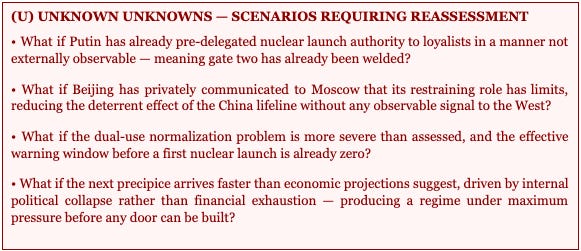
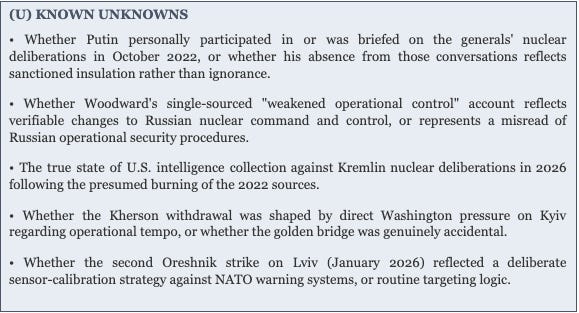
(U) ANALYTICAL JUDGMENT
Putin’s back was against the wall in 2022. The forces that brought him there — a failing military campaign, a regime under economic siege, and a personal survival calculus growing starker by the month — did not disappear with the Kherson withdrawal. They have been building since. The next crisis will not necessarily look like Kherson: armies crossing rivers, a single geographic off-ramp, a withdrawal to be announced on state television. It may look like a regime calculating, in private, that it has nothing left to lose — and finding, for the first time, that no door has been built.
The lesson of the fall of 2022 is the one the world keeps refusing to learn. The bomb stayed in the silo because the math said so. And math can change.
The National Security Desk offers these posts freely, but your support is necessary and appreciated. Please subscribe, paid if you’re able, or leave a tip.
Thank you

(U) REFERENCES
[1] Bob Woodward, War (2024). Woodward read the Austin-Shoigu transcript verbatim on NPR, October 15, 2024, and confirmed it was “a literal transcript.” Secretary Austin subsequently confirmed the account as accurate. See also Newsweek, October 8, 2024.
[2] Bob Woodward, War (Simon & Schuster, October 2024). The 50% probability estimate, and its progression from approximately 5% then 10% as the Kharkiv offensive developed, is reported in Woodward’s book and summarized in CNN, “New Woodward book reveals Biden’s alarm over potential Russian nuclear strike,” October 8, 2024. Woodward confirmed the account to CBS News, October 14, 2024.
[3] William Burns, Director of Central Intelligence, interview, CNBC, 7 September 2024.
[4] Jim Sciutto, The Return of Great Powers: Russia, China, and the Next World War (Dutton, 2024).
[5] Ulrich Kühn, “The Fall Crisis of 2022: Why Did Russia Not Use Nuclear Arms?” Defense & Security Analysis 41, no. 2 (2025): 280–300. DOI: 10.1080/14751798.2024.2442794.
[6] George Perkovich and Pranay Vaddi, “How to Assess Nuclear ‘Threats’ in the Twenty-First Century,” Carnegie Endowment for International Peace, January 2026.
[7] Vladimir Putin, address to the Russian Federation, September 21, 2022. Transcript: kremlin.ru.
[8] Ramzan Kadyrov, Telegram channel, October 1, 2022.
[9] President Biden, remarks at a Democratic fundraiser, New York, October 6, 2022. Reported by The New York Times, Reuters, and AP.
[10] Prime Minister Narendra Modi, remarks to President Putin, SCO summit, Samarkand, September 16, 2022.
[11] G20 Bali Leaders’ Declaration, paragraph 10, November 15–16, 2022.
[12] Vladimir Putin, Valdai Discussion Club plenary session, October 27, 2022. Transcript: kremlin.ru.
[13] “Russian Nuclear Threats 1999–2025,” Unconventional Nuclear Warfare, National Security Desk, nukes.substack.com (2025).
[14] Voice of America analysis of Russian nuclear statements, February 2022–December 2024; cited in NSD, “Russian Nuclear Threats 1999–2025.”
[15] Mark Kramer, “We Might Give Them a Few: Did the US Offer to Drop Atom Bombs at Dien Bien Phu?” Bulletin of the Atomic Scientists, February 26, 2016. NSC Planning Board minutes, April 29–30, 1954 (declassified). See also John Prados, Operation Vulture (iBooks, 2002).
[16] Sciutto, The Return of Great Powers (2024).
[17] “MAD MAN!” Unconventional Nuclear Warfare, National Security Desk, March 30, 2022. Available at nukes.substack.com. Inaugural publication of the Unconventional Nuclear Warfare channel; the channel was created March 28, 2022.
[18] “Tactical Nuke on Kyiv: Putin Has the Advantage,” Unconventional Nuclear Warfare, National Security Desk, April 20, 2022. Available at nukes.substack.com.
[19] Gen. Barry McCaffrey (USA, ret.), LinkedIn, April 2022, in response to NSD’s “Tactical Nuke on Kyiv.”
[20] C. Todd Lopez, “STRATCOM Commander Says US Should Look to 1950s to Regain Competitive Edge,” DOD News, November 3, 2022. Available at defense.gov.
[21] National Wealth Fund figures from Russian Ministry of Finance disclosures and UK Government statement to the OSCE (2025). $961 million gold export: multiple financial reporting services, November 2025. See also NSD, “Russia Is Near Collapse — Trump Is Putin’s Lifeline,” Civil War II, National Security Desk, February 16, 2026.
[22] “Vladimir Putin is losing his grip on Russia,” The Economist, May 9, 2026.
[23] Woodward, War (2024); cited in New Voice of Ukraine, “Biden’s team feared Russian nuclear strike at Kherson, Bob Woodward’s book reveals,” January 19, 2025.
[24] Bob Woodward, War (2024). Biden’s direct quote to Sullivan, as read by Woodward on CBS News, October 14, 2024.
The National Security Desk offers these posts freely, but your support is necessary and appreciated. Please subscribe, paid if you’re able, or leave a tip.
Thank you
This is a fake article. Russia never intended to use a nuclear weapon in Ukraine. Why would it do this when it is slowly and calculatedly winning the war against NATO? In addition, it would affect the people/land in Russia, plus the surrounding countries. Only a sick mind from the CIA or MI6 could think of such a morbid scenario, in which the use of a nuclear weapon is as natural as a visit to a store.
Such articles aim to instil the idea that it is better to lose the war (the reality on the battlefield clearly and bluntly states it) in Ukraine than for Russia to not use nuclear weapons. Please decide which propaganda line you are going for:
1) Russia is weak, it is left without soldiers/weapons/ammunition and therefore it will lose so there is a risk of nuclear escalation;
2) Russia is strong, it is winning the war against NATO in Ukraine and the bad guys that are and there is a risk of nuclear escalation.
Both versions cannot be valid at the same time.
So go easy on the propaganda or make it more "credible".
Ruzzian cities